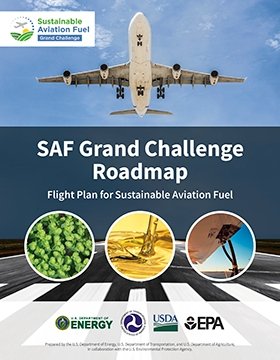
the full version of the SAF Grand Challenge Roadmap: Flight Plan for Sustainable Aviation Fuel
Download the full version of the SAF Grand Challenge Roadmap: Flight Plan for Sustainable Aviation Fuel. |
The Sustainable Aviation Fuel Grand Challenge is the result of the U.S. Department of Energy, the U.S. Department of Transportation, the U.S. Department of Agriculture, and other federal government agencies working together to develop a comprehensive strategy for scaling up new technologies to produce sustainable aviation fuels (SAF) on a commercial scale.
The Sustainable Aviation Fuel (SAF) Grand Challenge Roadmap outlines coordinated policies and actions by relevant U.S. government agencies to support stakeholders in realizing the goals of the SAF Grand Challenge.
The Roadmap enables agencies to coordinate activities in research, development, and demonstration to catalyze technology innovation, public–private partnerships, policy frameworks, and investments needed to address barriers to achieving the SAF Grand Challenge goals.
Under the Roadmap, federal agencies will coordinate with the aviation industry, fuel producers, agriculture, research, academia, state/local/tribal governments, and others to accelerate growth of a domestic SAF industry that utilizes U.S. manufacturing capacities and the U.S. workforce, contributes to U.S. energy security, aids economic growth in rural America.
The Roadmap has and will continue to incorporate input from key stakeholders to ensure alignment of government and industry actions. The Roadmap is the beginning of an evolving, collaborative, and dynamic process. Regular updates will be informed by technological progress, market developments, and analysis activities.
Action Areas for the SAF Grand Challenge Roadmap
The Roadmap lays out six action areas spanning all activities with the potential to impact the SAF Grand Challenge objectives of (1) expanding SAF supply and end use, (2) reducing the cost of SAF, and (3) enhancing the sustainability of SAF.
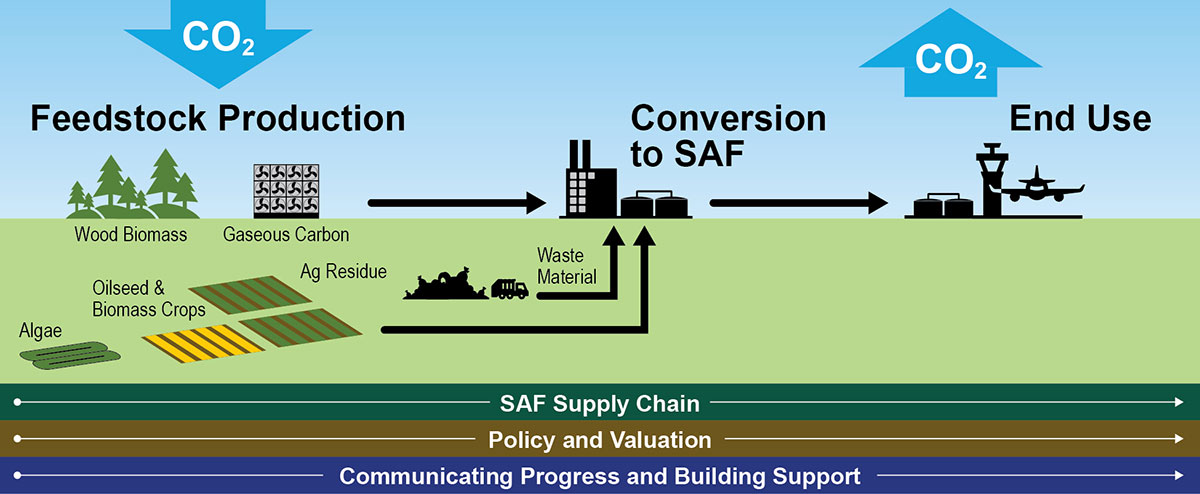
The SAF Grand Challenge Roadmap overview figure depicts how the six action areas address barriers across the entire supply chain from innovations in feedstock supply through end use. Within each of the six action areas are workstreams that define critical topics to be addressed.
|
|
|
|
|
|